Suit · pentacles
King of Pentacles
king of Pentacles
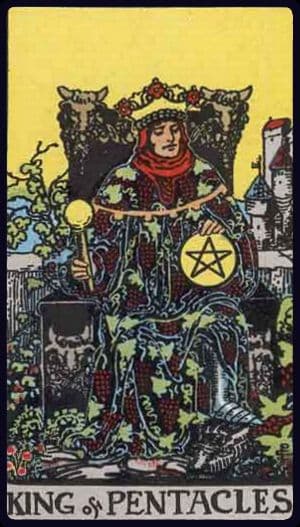
Image of King of Pentacles
The King rests on a throne draped with grapes and bulls, pentacle on his knee, city and vines at his back. He does not clutch his wealth; he presides over it. His power is in cultivation — turning earth and labor into a kingdom where people can eat, build, and belong.
An artistic retelling of the card's symbolism, not a historical treatise.
Symbols in this card
Details visible in this Rider–Waite–Smith image, read as prompts for reflection.
Grapes and vines
The growth around the throne shows abundance cultivated over time.
Bull carvings
The solid forms reinforce endurance and practical power.
Upright meaning
You are called to lead in the material realm — running a business, guiding a team, managing assets, or setting standards others rely on. The King of Pentacles embodies confident stewardship: prosperity linked to integrity and long-term thinking.
- Decisions grounded in experience and measured risk
- Generosity from strength, not from need for approval
- Building systems that support many people over time
Relationships
Stability can be generous when it supports mutual choice. Share practical decisions rather than letting provision become authority.
Work
Experienced stewardship can turn a good idea into a durable result. Build systems others can understand and maintain.
Money & resources
A strong base can support long-term aims. Assess success by resilience and usefulness as well as size.
Reflect: Where am I already a quiet authority in practical matters — and what would it look like to lead from that place with more clarity?
Try: Make one executive decision you have deferred — approve a budget, set a policy, or commit to a strategic direction — and communicate it clearly.
Reversed meaning
Material success may have hardened into greed, rigidity, or workaholism. Reversed, the King warns of using money or status to dominate — or neglecting relationships and health while chasing an endless more.
- Control that stifles creativity or trust
- Defining worth solely by income or possessions
- Short-term gains chosen over sustainable ethics
Relationships
Status or material comfort may be crowding out tenderness. Ask what the relationship needs beyond security.
Work
A focus on control or results can make people feel interchangeable. Revisit the values that the enterprise was meant to serve.
Money & resources
A lucrative choice may carry costs that a balance sheet misses. Examine dependencies, obligations, and the people affected.
Reflect: What would I protect if profit and reputation stopped being my primary scoreboard?
Try: Audit one area where control or spending reflects fear rather than values, and adjust a single rule toward fairness or rest.